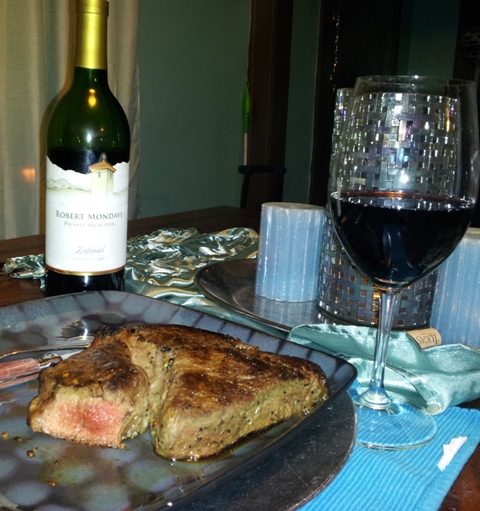
Zinfandel and Sirloin Tip Steak Pairing
Photo by Melody Flammger
Most people try to follow a set of textbook rules when it comes to food and wine pairing. I'm here to tell you that everything you've heard/read is probably okay to follow- but to make a truly great pairing you have to take some risks. Some say that the best food and wine pairings are when you take your favorite food and your favorite wine, put them together and they enhance each other. Others just say to play around with it to see what works together. It's definitely a mixture of both, so don't be afraid to challenge old rules!
Zinfandel
Photo by Melody Flammger
The Wine:
2007 Robert Mondavi Private Selection Zinfandel
See/Swirl: Very deep garnet color, visible legs though this is a red
wine they don’t stain the glass. No
sediment.
Sniff: vanilla, black cherry, currant, charcoal/ sweet barbeque, strawberry
Sip: surprisingly mellow and velvety (soft tannins, dark fruit), definite acidity and toast on the tongue.
Steak
Photo by Melody Flammger
The Steak:
Angus Choice Sirloin Tip Steak prepared with Montreal Steak Seasoning and pan seared until rare. This works best if the steak is allowed to acclimate to room temperature before cooking.
Together:
The acidity in the wine cuts through the fat in the steak- one of the main reasons this pairing works well together. The steak seems to bring out the toastiness in the wine more (from oak) and gives the spices on the steak a backbone to stand against. The surprisingly mellow tannin didn't overwhelm the delicate flavor of the rare steak like a bolder wine may have.
Photo: Melody Flammger
Butterfly Wine by Lucas Vineyards
Most blind tastings are done without the tasters knowing anything
about the wine. When doing a blind tasting, the administrator will even
cover the bottles of wine with a paper bag so that nothing is known about them.
The goal of the blind tasting is to be able to guess the grape type the
wine was made from without knowing very much about the wine- as little as
possible in fact. Without some serious
administrative help, most of us are unable to do completely blind tastings, but
now and again we come across a wine and think "Now, what in the world
could this wine be?"
This is because
many wineries have taken to a minimalistic approach in their labeling.
This makes the wines look attractive and/or unique but presents a problem
to the already overwhelmed wine consumer.
Many times I’ll pick up a wine bottle in the store and scan the bottle
looking for some kind of a description or an idea of what grapes were used,
etc. Sometimes I’ll find a satisfactory
answer by looking around but sometimes I won’t.
In these cases, I have to either pick up the bottle and take the risk of
not liking it when I open it up or put it back down and go for a wine that
tells me a little more about itself.
Luckily, I can usually guess pretty well by the descriptors on the
bottle if the wine is going to appeal to me or not. I can imagine if this isn’t the case for
everyone, especially those who don’t know what they’re looking for in a
wine. That said, this time I did pick up
a bottle that I was drawn to by the label and decided to try it. The wine doesn’t tell you a whole lot up
front. The name is a bit ambiguous “Butterfly”
and the winery, Lucas Vineyards is in New York. I’ve
never had any of their wines before so I decided it would be a good opportunity
to try my skills.
As always, I start with my 4 S’s (See Better wine tasting for more
on these).
Photo: Melody Flammger Glass of the "Butterfly" wine by Lucas Vineyards
See and Swirl:
The color on this wine is very clear with no discernible legs on
it. I can interpret these findings as
that the wine is likely unoaked and relatively low in alcohol content. The wine
is probably a young white wine.
Smell:
Lemon and green apple come to the forefront of the nose on this
wine with a hint of a floral aroma.
Using quick, short sniffs I can also detect a hint of honey on the nose.
Sip:
The green apple flavor hits the tongue first, followed by the
floral taste as well finishing with a honey aftertaste. The wine is both zingy and sweet. The zinginess
is likely caused by a high acidity in the wine and the sweetness is a
moderate amount of residual sugar in the wine.
Given what I know about the wine so far, I can almost conclusively
rule out vinifera grapes. First, most
wineries in the U.S. will advertise these vinifera grapes in order to sell the
wine more easily and for a higher price because these grapes are considered to
be noble. The vinifera grapes I am
ruling out are: Chardonnay, Riesling, and Sauvignon Blanc. This means that the wine was likely made from
labrusca grapes (native grapes). There
are many different varieties of labrusca grapes including: Delaware, Golden
Muscat, Ontario, Seneca, Cauyuga and many others.
Because many wineries in
New York use different labrusca grapes based on their locations and even blend
the grapes to balance out their wines, it is possible that without writing the
winemaker themselves we may never know the grape that was used to make the
wine. Thus, I suppose in this blind
tasting I have failed to identify the grape that was used but was still able to
determine quite a bit about the wine just from what I could discern. We all get better at these sorts of exercises
with practice- and next time I’ll use a European wine so that there are a
finite number of possibilities. I
certainly enjoyed the adventure and this wine was a winner in my book.
As always, continue to explore and don’t be afraid to try this
experiment yourself. You may surprised
at what you know!
There are four S’s so to speak when first experiencing any
wine. They are in order: see, swirl,
smell, and sip. I realize that many
experienced wine drinkers might find this post a bit redundant- a lesson they
learned long ago- which is why I am going to explain what all 4 of the S’s tell
us as well as what one might miss in the wine drinking experience if one were
to skip over one or all of them. These simple things can tell us a surprising
amount about the wine before we even consume it: there are wine connoisseurs
who can tell us what the wine is without ever looking at the label!
For more of a visual, please refer to my post from last
quarter where I taste and compare two Rieslings:
See:
How the wine looks can tell us a lot about the wine. The color, first will indicate whether the
wine is white, red, or rosé. The presence of
bubbles will indicate whether the wine is sparkling or in the case of vinho
verdé
just slightly bubbly. Debris in the bottom
of the glass (be them tartaric acid crystals, dead yeast (lees), or pulp) can
also tell us a bit about the wine depending on what is found. Beyond those basic visual indicators, the
color can tell us other things.
In a white wine, one may look at the color of the wine and
be able to tell several things. If the
wine is aged, it may have a darker color than a very young white wine. Aging in white wines is a little less common
than in red wines due to the fact that reds tend to age better but certainly
some aging has been done quite well with some white grapes. Most notably, Rieslings tend to age well but
there are others. Another factor that
can affect the color of a white wine is whether or not it is oaked. Oaking a wine can drastically alter the color
of the wine depending on how long the wine is in the barrel or even what type
of barrel is used. Typically, an oaked white wine will have a fuller, darker more golden color to it. Finally, another factor that can change the
color of a white wine is the alcohol content.
Alcohol can sometimes cause wines to have a darker more golden
color.
In a rosé, one may look at the color to judge
whether the wine is being drunk in time.
Rosé
wines are seasonal because of their delicate color, which can become more
orange-brown tinged if they are not consumed in time. These wines are literally a cross between a white wine and a red wine and are made in two ways: either the wine is made from red grapes and only allowed to ferment on the skins for a short time or the juice from the grapes naturally has some color to it. This is why the color and taste of these wines are so delicate. The tingeing of color is not the only
disappointment if these wines are held on to for too long- the taste can suffer
greatly as well. The season for rosé
wines tends to be spring and early summer.
In a red wine, one may actually be able to determine the type of the grape used to make the wine.
Pinot noir, for example, will have a very telling watery edge around the
glass with a dark garnet center. Red wine can also, like the rosés acquire an orange-brown tinge to indicate that
the wine has been aged a very long time and possibly oxidized a bit. In these older wines, you would also likely
notice that the wine had shrunk in volume a bit over time also due to oxidation.
Swirl:
Not only will swirling the wine stir up the aroma and
oxidize the wine a bit- it can also tell you more about the wine. Swirling the wine, you want to look for the
wine to stick to the sides of the glass and run down. This effect is called “legs” and can indicate
a higher alcohol content than a wine with less or even no legs. The next “S” (smell) starts with swirling.
Smell:
“If you do not smell a wine or simply take a brief cursory whiff,
very little information goes to the brain, and not surprisingly, you will have trouble
deciding what the wine tastes like.” I
took this quote from Karen MacNeil’s The Wine Bible because she sums it up so perfectly. Much of what you taste in your wine will
actually come from what you smell. For
this reason, smell is a very important part of a proper wine tasting.
There are a lot of smells in wine from barnyard to basement
there are literally hundreds of descriptors which have been used over the
centuries. Most commonly, one will smell
a mix of different fruits but there are also floral scents, nutty scents,
mineral scents, even the smell of petrol has entered in now and then. To simplify tastings, Ann C. Noble invented
an aroma wheel which many find useful starting out.
The smells in a wine can tell us about how the wine was
made- in some cases they can tell us what grape the wine was made from, whether
oak was used or not, whether malolactic fermentation was used, etc. I’ve even smelled sunshine or the countryside
in a few well crafted wines. I have the
best experience when I let the wine “talk” to me and tell me about itself. I do this by following the whole process and
not trying to smell for specific descriptors but rather put a name on the ones
that come to the forefront. This way,
you can get a feel for the wine.
Sip
A tip from my Wines Professor Lorraine Hems who teaches in
the Hospitality program at RIT is to throw away the first sip of wine. Why, you may ask? This is because you may have eaten something
or drank something throughout the day that would taint your palate. In order to get the best first impression of
the wine, you almost want to swish the wine around on the first sip and either
spit or swallow when finished. Never
evaluate on the first sip.
Now that palates have been cleansed it’s time to taste all
of the beautiful descriptors you found in the nose of that wine. This is where
the wine comes to life. With tasting,
there are three main flavors you will notice: sweet, sour and bitter. Salt is largely excluded because it’s extremely
rare to find a salt flavor in a wine.
The only grape variety I know of to have a salty flavor is the trebbiano
grape which is used in the making of balsamic vinegar. This grape is rarely used for wine.
Sweet, sour and bitter have attributions to specific
qualities in the wine. Sweet is
attributed to the residual sugar (or added sugar) in the wine. Residual sugar refers to sugar that was not
fermented out of the wine by the yeast.
Sour is attributed to acid in the wine.
Acidity can have a lot of bearing on the flavor of the wine making it
very tart or in more balanced wines making it well rounded. Finally, the most common source for a bitter
taste is the tannin which typically only occurs in rosé or red wines.
I hope this has been an interesting review even for the
experienced wine drinker, and as always- enjoy your wine!