Tuesday, January 1, 2013

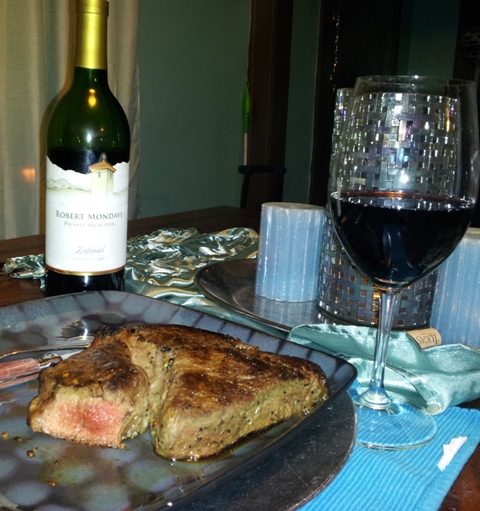
Red Right Hand with... of course... steak!

Photograph by Melody Flammger
Steak paired with Red Right Hand wine
Photograph by Melody Flammger
Red Right Hand Bottle
See/ Swirl: This wine has a deep garnet color upon first glance.  When tipped to a 45 degree angle there is no watery edge- which is not expected as this is not a pinot noir.  I did, however, find tartaric acid crystals at the bottom of the glass.  Swirling revealed legs on the sides of the glass, meaning that the alcohol content is relatively high.
Sniff: This wine reveals notes of caramel, vanilla, black pepper, and cherry.
Sip: butterscotch followed by sour dried cherry and pepper on the finish

Photograph by Melody Flammger
Steak Cooked Rare
When paired with steak, the tannin and acid in the wine balance with the fat from the steak perfectly.  This allows the pepper flavor from the steak seasoning to stand out more.

Happy New Year!


Today as I was browsing through some of the blogs I follow, I noticed a Gizmodo headline that caught my attention here.  They're champagne flutes that exploit surface tension in a way that causes your champagne to continue to bubble until the glass is empty.  The flutes are laser etched in order to achieve the effect (one of the many ways technology is improving our wine experiences).  Better yet, the glasses aren't even that expensive.  They're about $25 for a pair.  While I haven't tried these myself, I am quite tempted to buy a pair!

Monday, July 9, 2012

Sockeye and Lager

Shadow's Wild Black Premium Blackberry Lager
Photograph by Melody Flammger
Shadow's Wild Black Premium Blackberry Lager
Photograph by Melody Flammger
I've noticed I do a lot of pairings with salmon at this point.  It's probably because it's so versatile and it's one of my favorite types of fish to work with.  It also happens to pair with a lot of different beverages.  That said, this is unique because I've paired fish with beer (something I haven't done before).  Without further ado, on to the food and beer pairing!

Beer:

  • See: very garnet in color- not a common color for a lager.  There is also very little head on the beer.
  • Sniff: Blackberry, cherry and hints of molasses 
  • Sip: Blackberry and cherry on the forefront with and almost woody backbone
  • Swallow: Clean and crisp finish with very little aftertaste.


Sockeye Salmon and Steamed Peas
Photograph by Melody Flammger

Food:


Wild Alaskan Sockeye Salmon with a side of steamed peas.  The salmon was flavored with seasoning salt and black pepper and then oven-baked skin side down until flaky.  The peas were microwave steamed.

Food and  Beer:


The fattiness from the salmon immediately softened the woody and bitter flavors in the beer.  Because of the more bitter flavors being softened, it allowed the blackberry flavor to shine.  Paired with the fish, the pairing was almost like eating a glazed piece of salmon rather than two separate entities.  It was an excellent combination.  I even forgot to sample the peas with it, but they were more for a vegetable than for actual tasting value.

Sunday, July 8, 2012

Bagged up to go?

Bag Wine?
Photograph by Melody Flammger
I stumbled across this interesting find during my latest trip to the liquor store. It's apparently a new take on boxed wine.  The purse shape camouflages the fact that it's boxed wine (as much as it can anyway).  I really liked that they even displayed the product on a retail purse rack, which adds authenticity to the idea that it's purse-shaped box wine.

It seems like an opportune time to introduce a product like this one because the weather has been gorgeous and many beaches and parks have rules about glass containers.  A few other wineries have tried things like tetra packs and bagged wine with a spout on it- but I've never seen anything this intricate or thought out before.  While I can't say anything about the flavor or quality of the wine itself, I can say the concept caught my eye!


Monday, May 21, 2012

Why wine?

Photograph by Melody Flammger

Wine is the reason I decided to completely change my career path and veer off in another unknown direction.  Often, others will ask me or just assume what the reasons are that I might have made such a risky maneuver- particularly when I had a perfectly reasonable career path lined up for myself.  The reasons are many and varied but they essentially boil down to a few really big and amazing things about wine.

Wine as a Science

As a part of my first class in the subject taught at RIT by Lorraine Hems, I decided to make a wine for my project.  I realized the relevancy of my scientific training in Biomedical Sciences (my program of study at the time) during the wine making process.  I loved both as a scientist and somewhat of a nerd, the fact that something so wonderful could come of the process and was able to more fully appreciate the fruits of my efforts in a tangible way that could be shared with others.  My printouts of gel electrophoresis or successful production of monoclonal antibodies paled in comparison to the joy I felt opening my first bottle of self-made wine.

Wine as an Art

Wine is so much more than any one action you do with it.  Wine is about tasting, smelling, seeing, swirling, making, sharing, scoring, buying... Wine finds so many ways of expressing itself.  It transcends all of the senses and comes in limitless forms.  Wine is made from different types of grapes, barrels, yeasts, procedures.  The possibilities with wine are literally endless.

This is where the wine making process becomes more than just a laboratory procedure to be carried out.  There is more than one way to get the desired result and deviation is encouraged.  Deviation from the standard procedures finds beautiful anomalies.  Somewhere in this process, a grape becomes more than just wine but a unique collection of smells and tastes.  As many wine makers have said, there is a bit of alchemy involved in wine making.

Wine with Food

If I thought wine was amazing by itself- the right food makes it even better.  Food and wine pairing is a wonderful tasting adventure to embark on and really brought many of my wine experiences to life for me.  Instead of sitting down to a single glass of wine, the act of planning a dinner around a wine or vice versa became an experience unto itself.  My husband, Chris Flammger even enjoys planning these pairings with me.  We've recently expanded to doing food and beer pairings to incorporate his tastes as well.


Friday, May 18, 2012

Mass wine tasting

Wine tasting table
Photograph by Melody Flammger
I attended a tasting held at my local Lilac Festival.  For some reason, when I attended this tasting I thought of previous wine tasting events where there was plenty of room to move about and politely converse about the wines we were trying.  At previous events, ticket prices were higher, venues were indoors and a different crowd was present.

First of all, this event was a smaller part of a larger outdoor festival held in one of the larger city parks.  The tastings themselves occurred in a large tent and tables lined the edges of the tent with one larger one in the center.  The center winery was Casa Larga Vineyards (this made sense because they largely sponsored the event).  Upon entering the tent, my original assumptions were shattered.

For $5 at this event, you got a tasting glass and basically unlimited tastings- IF you could get to the tastings.  The problem was that many people would stand around the tables for long after they'd tried their samples instead of moving along.  This led to overcrowding and people were reaching over others just to try to get a sample.  In many areas of the tent, it was impossible to pass easily on to the next table.  The area became so crowded with people that no one could easily move.  I hadn't anticipated having so much trouble even moving around.

Wine tasting table
Photograph by Melody Flammger
Instead of taking tasting notes, my friend Kat and I focused on collecting winery brochures so we would know which wineries had attended and could refer back to their websites if we liked anything we had tried.  We tried the wines that sounded interesting or that we hadn't had before rather than doing a complete tasting at any one winery.  If we had tried to get a whole lineup in, someone would have pushed us out of the way.

This really opened my eyes to what can happen if there isn't a good crowd management system in place.  There was one security guard stationed at an exit to the tent, but no ropes for lines and no apparent organization.  We noted quickly to each other the difference between an event like this and an event for serious wine drinkers.  Unfortunately, what could have been a very nice event for serious wine appreciators it had become the ultimate drunk fest.  After all, if you can get unlimited samples with your $5 entry fee, you wanted to get your monies worth and that was done by trying as many wines as possible- sometimes even multiple times.


We managed to have a good time despite the event not being what we expected.  We ultimately decided that if we're going to go to an even where there is a massive tasting such as this one that we'd have to keep a notebook to have an idea of what we tried, or to abandon trying to gather tasting notes for each wine.  We made a mental note of some of the wines we liked but a list may even have been better.

Have you had a mass tasting experience?  What was it like?

Saturday, May 12, 2012

Catfish blanc


Explorador Sauvignon Blanc
Photograph by Melody Flammger
2010 Explorador Sauvignon Blanc


See/Swirl: This wine, like most Sauvignon blancs is very light color.  This is probably due to the young age of the wine.  Swirling reveals that the wine has definite legs and these are indicative of the 13.5% alcohol content listed on the bottle.

Sniff: I get definite lemon zest, apple skins and another bitter, sour smell I can't put my finger on.  I think it's gooseberry (a classic descriptor of Sauvignon blanc).

Sip: The flavor is lemony and acidic with light fruit on the back end.  I've previously referred to this wine as being a lemonade replacement and this one lives up to the name due to its tartness and lemon notes.


Citrus Dill Catfish
Citrus Dill Catfish with Steamed Vegetables and Garlic Flatbread
Photograph by Melody Flammger

The first word out of my mouth after tasting this was "Meh."  The flavors canceled each other out. The dill was too subtle a flavor to stand against the bright flavors in the sauvignon blanc and there wasn't enough fat in the fish to balance out the acidity in the wine.  The whole thing fell flat for me.  This is a learning experience though. Pairing flavors that seem similar to each other can cause problems is pairings.  Sometimes they work out spectacularly and others they don't.  This is a learning experience.

Garlic Flatbread


I knew that the two would go together, so the whole meal was not a miss.  The acidity in the wine enhanced the garlic flavor and the fat in the cheese was enough to buffer the acidity in the wine.  Because of that acidity being brought into balance, the fruit flavors in the wine came forward and the pairing transformed.


Friday, May 11, 2012

Barbecue and beer

This is the first time the blog has really delved outside of the topic of wine, but with the Summer upon us I decided to address the food of the season: Barbecue, and it is typically best with a beer.


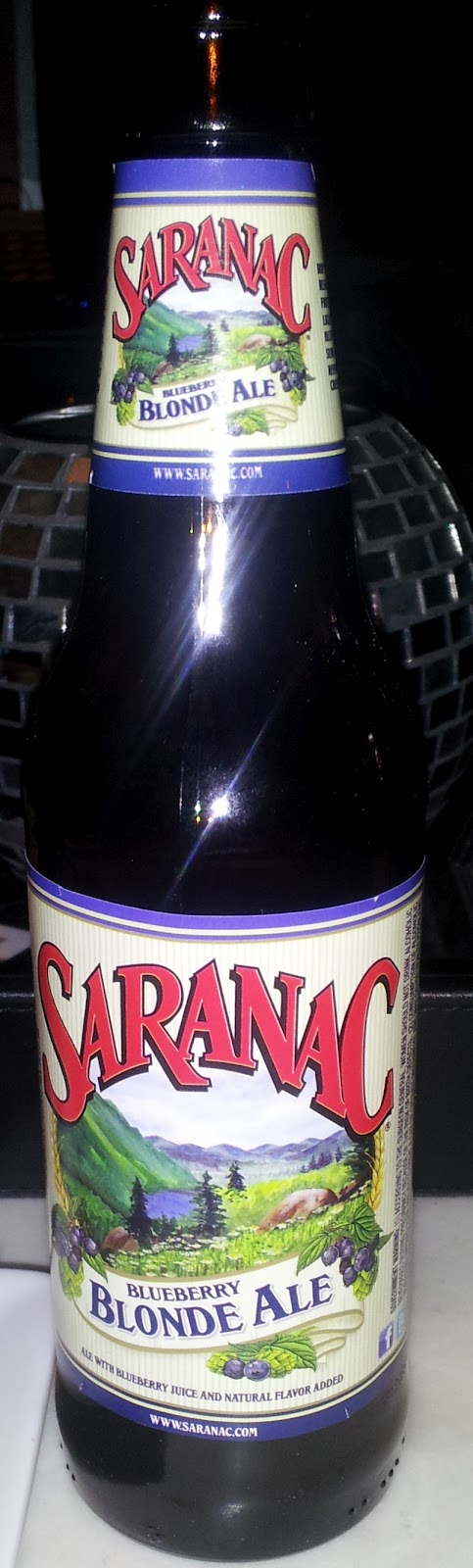
Saranac Blueberry Blonde Ale


See:
About a "2" on the color scale (1 being the lightest and 8 being black).  There's a little bit of a head on the beer and visible bubbles.  The beer is apparently unfiltered, as it's a bit cloudy towards the end of the bottle.


Smell:
Blueberries, honey and bread are the main aromas


Sip:
I tasted just a little sweetness on the front end, being inundated with hops and bitter skins of blueberries on the middle of the sip.  My husband (who is a self-proclaimed hop head) got a lot more of the fruit from the blueberries on the front end of this beer.  Your tasting experience will depend on your preferences and your sensitivity to certain flavors.


Barbecue Chicken


Once paired with the chicken, I was able to pick up on the fruity flavors my husband had described to me in the initial tasting so the food certainly brought out some flavor in the beer.  Additionally, the hoppiness in the beer brought out the spice in the barbecue making the pairing mutually beneficial to the food and the beer.

Brown Sugar Baked Beans


The beans paired with the beer similarly to the way the chicken did.  The spiciness was picked up by the hops flavor in the beer and the sweetness in the beer was picked up by balancing the hops out against the food.  Overall, I felt both items went well with the beer.

What is your favorite Barbecue pairing?

Saturday, May 5, 2012

Summer wine

Patio Wine
Photograph by Melody Flammger

I love how nice the weather has been lately and realized that as we head into Summer, there's a whole different feel to the kind of wine we want to drink.

Here are some wines I recommend for while you're chilling on your patio or just hanging out with friends:

Photograph by Christopher Flammger


Red Newt Cellars Blue Newt White:


I recommend this wine because it's a nice, lightweight wine that is sweet enough to stand on its own.  It's still zippy, acidic and fun- as any good patio wine should be.  The balance between the high acidity and high sweetness is something I love about many of the Finger Lakes wines.


Photograph by Christopher Flammger


Hazlitt Vineyards Red Cat:


If you haven't had Hazzlitt's Red Cat already, it's a must.  Just about every winery's success has been compared directly to Red Cat's.  The idea behind Red Cat is the same as any patio wine- easy drinking.  I find the occasional bottle enjoyable.  The "Red Cat" name comes from the fact that it is made from a grape called "Catawba", which is a red grape native to New York.


Photograph by Christopher Flammger


Xplorador Sauvignon Blanc:


This was the most recent Sauvignon Blanc purchase I've made.  I generally prefer Sauvignon Blanc from New Zealand but will be giving this one a try.  Sauvignon Blanc is a great patio wine in general- no matter which style you like because it tends to be juicy, mouth watering and acidic just like lemonade.  Perfect for the patio if you ask me!

Friday, May 4, 2012

Thirsty Owl and cranberry pepper glazed salmon

Cranberry Pepper Glazed Salmon and Pan Seared Corn
Photograph by Melody Flammger
I came home to a surprise food and wine pairing prepared by my husband on Wednesday after a long night at work.  He's a much better cook than myself and I usually enjoy what he brings to the table.  Without further ado, here's the food and wine pairing:

Thirsty Owl Wine Company's Blushing Moon Wine
Photograph by Melody Flammger

Thirsty Owl Wine Company Blushing Moon:

  • See/swirl: I see a pale rose color, almost peachy.  There are no legs and no sediment.
  • Sniff: I smell fresh strawberry, peach and kiwi.
  • Sip: I find that the kiwi scent carries through to the taste, which is pleasantly zippy with a hint of strawberry.  The wine is very acidic and sour, which is typical of the Finger Lakes Wine Region. 
Cranberry Pepper Glazed Salmon
Photograph by Melody Flammger


Cranberry Pepper Glazed Salmon:
Pan Seared Corn
The acidity of the wine is balanced out by the fattiness of the fish.  The peppers in the glaze get a bit of kick off from the wine, increasing the heat on the spice.  The sweetness from the cranberries is welcome and evens out the whole thing.  I really enjoyed the way the wine and food played off of each other because they both transformed beautifully.  Of course, both the food and the wine were delicious on their own as well.


Corn Seared in Salt and Butter:
The sweetness in the corn offsets the blatant acidity of the wine and the two coexist quite peacefully.  There was no miraculous transformation as with the salmon but still a nice pairing.


Saturday, April 28, 2012

Mighty Taco wine pairing


Video by Melody Flammger

Okay, so the new Mighty Taco opened up recently in Henrietta, NY and I couldn't help it.  I wanted to see if the Opera Prima Sweet Pink Wine went as well with spicy food as it said it did and that was the perfect excuse.

Thursday, April 26, 2012

Geographical challenges

Screenshot Captured by Melody Flammger

I wish this could have been a post with video of a virtual tasting with my best friend from childhood, Brianna Cole who is currently working and living in Chiba, Japan.  The idea was that we would break down the geographical barriers with something that is seemingly available everywhere- wine.  It turns out my assumptions about wine were false to begin with.  Due to the enormous amount of wine on the market, each person has a relatively limited selection of wine in their area and short of ordering a specific wine, it seems that the virtual tasting is not so simple to do.  The other thing I found was that different wineries make different wines available in specific geographical locations.  Determined not to disappoint, I'm still working on the problem.  We may resort to deciding on a wine and ordering it if that's what we have to do.

Saturday, April 21, 2012

Pinot noir: trends and tasting

Video by Melody Flammger, Editing by Melody Flammger, Tasting by Melody Flammger... EVERYTHING by Melody Flammger- except the wine.

Thursday, April 19, 2012

Mead is different

Wine making notebook
Photo by Melody Flammger
Recently, my wine making partner and I started making wine again.  We've been wine making partners for years, with our first batch having been started when we took our first wine dating back to early 2010.  The first wine we made came from a kit- it was a Strawberry Riesling.  Since then, our operation has become slightly more sophisticated and we tend to make our wines from scratch.  This time we made a mead.

Because most of you already know how to make your own wine or even have, I'm just going to share my experience making the mead with you.  For more information on wine making, please read my post Wine Making 101.  

Mead is different from other wine making ventures because instead of using grape juice or fruit juice for a sugar source, it uses honey.  The use of honey somewhat complicates the wine making process.  Rather than essentially adding yeast to juice there is a bit of preparation that happens.

Differences in preparation:
Removing the raisins
Photo by Melody Flammger

  • Egg is used.  
  • Raisins are added
  • The honey, water and egg are boiled during the preparation process

 The differences added up to having to boil the three ingredients (honey, water and egg) and stir constantly until the "scum" rose to the top of the batch.  This was presumably to allow the egg to bind to the impurities in the honey and remove them from the finished product.  After the boil, raisins were added and the "must" was allowed to sit overnight.  We assume they were added for flavor- we are following a recipe as this is our first mead.  The picture to the right depicts me in the process of straining out the raisins as the must is being added to the carboy for fermentation (this is only a 1 gallon batch).  The cloudiness in the carboy is because the yeast solution has already been added.

Mead in the carboy with airlock
Photo by Melody Flammger


 With only a few differences from traditional wine making, mead is relatively simple to make.  This was a practice batch for a larger 5 gallon one to come.  1 Gallon batches are used to test the techniques, yeast used and additives without potentially ruining a large volume of supplies and I find are a more cost effective way to experiment in wine making.  me

Pro-tip: Always keep a log of your wine making so that you know what techniques worked and what techniques didn't.  We use ours to also plot potential costs of supplies, cost of the batch, recipes and more.  The scientists in us wouldn't have it any other way- but it helps to know what you did if your batch is successful so that it can be easily replicated for success every time.

Thursday, April 12, 2012

Wine-making 101

The illustrious hobby of wine making:

This post covers the very basic principals of wine making.  It's a very in-depth topic and will be discussed in more detail later on. If you’ve never made your own wine before it may sound like an arduous process. Most think back to the Romans, stomping the grapes with their feet and pressing it into wine. Luckily, the wine industry has advanced signifigantly since those times and making wine is easier than ever.

First, a little background information:

“Alcohol is what results when yeasts metabolize with the natural sugar in grape pulp.” 

Using this principlemaking wine is almost as simple as adding some yeast to some grape juice. Granted, it’s slightly more complex than that. After all, there are different styles of wine and different types. Nonetheless that is how wine is made with a few extra steps in between.

Mechanical Harvester
Photo courtesy of AP Images
Usually, in order to get the grape juice/pulp in question there is a harvest that is done. Originally, all harvests were done by hand. However, in this technological day and age we now have mechanical harvesters which most farms use to obtain their grapes. From the harvester, the grapes are usually placed into the crusher/stemmer. This device squeezes the juice out of the grapes and removes the stems. Crushing is done in different ways. Many wineries will just use the “free-run juice” that comes off before the first crush. This is for higher quality wines and white wines usually. When making red wines, we will save the skins and ferment them with the juice. More crushing of the grapes is usually to get more color and/or flavor from the skins of the grape.   

If you're just starting out, you'll probably want to purchase a kit for your first time.  They come with step by step instructions to ensure that your first wine is a success.

Now that we have juice, we need to turn it into wine. It is important to note that most places have ambient yeast (meaning that the juice will in fact ferment on its own if we do nothing).

 “A winemaker, however, may choose to use cultured yeasts, thereby gaining control over the onset and rate of fermentation. Something as simple as the speed at which fermentation proceeds can profoundly affect the flavor of the wine, with slower fermentations often producing more complex wines.” 

Many home wine makers will also want to select a cultured yeast from a lab such as Lalvin. This allows you to select a yeast that is going to impart the specific flavor profile you are looking for in your wine.  The selection process can be intensive and it is best to use a manual such as Scott Laboratories Fermentation Handbook.

Once the juice is fermented successfully it is officially wine. However, it is still not ready to drink. The next step is to stop the fermentation process to make sure that a secondary fermentation does not happen in the bottle (this can lead to messy explosions if not done properly). Many modern wineries use pasteurization to kill off the remaining yeast while others rely on additives or micro-filtering. For home wine makers, a campden tablet per gallon and a potassium sorbate or sulfite additive will do just fine. Some wine makers would not consider the wine nearly complete at this stage.  Many wines are aged for years in oak and home wine makers might use oak barrels or additives to simulate the ask flavoring which would be acquired by barrel aging.

You will need one of these if you want to bottle your wine
Corker
Photo by Melody Flammger
Now that we have wine that won’t explode when we bottle it, we must now clarify the wine. Who would want to drink wine with floating masses in it? In order to do this, many rely on clarification agents, however this can also be done through filtration. Different filters can be used for different effects. For instance, if you are trying to filter out leftover yeast, you may want a micro-filter which filters to 1 micron thick. That way, none of the yeast can pass through the filter. If you are just filtering for aesthetics, you can use a coffee filter or a wine filter you can find in any supply store where you go for your wine making needs. For clarification, I like the use of sparkoloid powder. After adding this clarifiying agent you would want to let the wine sit for an additional week or so to give the agent time to pull the sediment to the bottom of your fermenter. I do recommend use of a filtration method along with the clarifying agent to ensure better looking wine once it is bottled.

Source: MacNeil, Karen. "Where It All Begins, How Wine Is Made." The Wine Bible. New York: Workman Publishing, 2001. 7,32. Print.

Tuesday, April 10, 2012

Hope for new wine drinkers (and not so new ones alike)

After reading the latest Wine Spectator article by Matt Kramer, I couldn't help but share with my readers.  The article makes the point that in order to have a good palate, you don't necessarily need to be able to identify wines blind or know the most about wine.

"Judgment and insight are the hallmarks of a good palate. Everything else is a technicality."

The cool thing is that experience will give you both judgement and insight if you allow the wine to tell you about itself.  I tend to try not to read the descriptors on the bottle when I'm tasting because they can alter your perception of the wine.  Instead, I just use my 4 S's and experience the wine that way. As you taste more wine, the differences and little nuances of each wine will float to the surface and your palate will develop.

Keep tasting!

Thursday, April 5, 2012

Trip to the liquor/wine store


The New York section at a local store
Photo by Melody Flammger
Last time I had occasion to go shopping for wine, I considered the possible causes of one of the statistics we heard in my Wine, Beer and Spirits Marketing class at RIT.  The statistic was that 24% of wine consumers are overwhelmed when they walk into the liquor store.  That is a huge market share and to harness it would be...well... a marketer's paradise.

Considering carefully the potentially less knowledgeable wine consumer, I proceeded with caution.  Walking in, immediately there were cluttered shelves and displays of featured wines.  The wines not being featured were arranged by region.  That arrangement is fine if the consumer knows which region they want a wine from or knows what they are looking for- but as I began to consider the arrangement I honestly felt overwhelmed by the possibility of having to look over the entire store if I did not know which region(s) produced the style of wine I was looking for.  This may be just one reason some consumers are overwhelmed.

Worse yet, when I got to the New York section I realized that I had no idea what I wanted because I was on a budget and wanted to try something new but did not know what.  As I carefully scanned the bottles looking for a wine to call out to me- a wine salesperson did.

In the past, I'd had good experiences with salespeople and accepted his help.  I explained I was looking for something different and was intent on getting a New York wine because I wanted to support our local wineries.  I suggested maybe I try a red or a rose, those being wines that New York is not well known for.  Instead of helping me in my quest, the salesperson felt the need to insert his opinion- which was very pointed about New York wines.  It was totally off-putting- and yet that may be another reason consumers feel overwhelmed.  If the people who are supposed to be there to help you do a poor job of being receptive to your taste or choices, it only serves to make the selection process even harder.

Eventually coming out of the store with my three selections for around $20, I thought about it.  If someone less stubborn than myself had been listening to that wine salesperson they would most likely do one of the following:

  • Walk out without buying anything
  • Follow the salesperson's advice and buy a European wine instead
  • Buy a New York Riesling (as that's apparently the only thing NY does well?  REALLY?)
  • Never seek the advice of a salesperson again
What would you do?

Monday, April 2, 2012

Zinful steak

Zinfandel and Sirloin Tip Steak Pairing
Photo by Melody Flammger
Most people try to follow a set of textbook rules when it comes to food and wine pairing.  I'm here to tell you that everything you've heard/read is probably okay to follow- but to make a truly great pairing you have to take some risks.  Some say that the best food and wine pairings are when you take your favorite food and your favorite wine, put them together and they enhance each other.  Others just say to play around with it to see what works together.  It's definitely a mixture of both, so don't be afraid to challenge old rules!

Zinfandel
Photo by Melody Flammger


The Wine:

2007 Robert Mondavi Private Selection Zinfandel

  • See/Swirl: Very deep garnet color, visible legs though this is a red wine they don’t stain the glass.  No sediment.
  • Sniff: vanilla, black cherry, currant, charcoal/ sweet barbeque, strawberry
  • Sip: surprisingly mellow and velvety (soft tannins, dark fruit), definite acidity and toast on the tongue.


Steak
Photo by Melody Flammger


The Steak:


Angus Choice Sirloin Tip Steak prepared with Montreal Steak Seasoning and pan seared until rare.  This works best if the steak is allowed to acclimate to room temperature before cooking.

Together:


The acidity in the wine cuts through the fat in the steak- one of the main reasons this pairing works well together. The steak seems to bring out the toastiness in the wine more (from oak) and gives the spices on the steak a backbone to stand against.  The surprisingly mellow tannin didn't overwhelm the delicate flavor of the rare steak like a bolder wine may have.

Friday, March 30, 2012

Ratings and medals


Image created by Melody Flammger

We all see the various wine ratings cluttering the shelves in the liquor store- this Chardonnay scored 96 points, this Cabernet Sauvignon scored 88 points, etc.  But do points really matter?

It depends on who you talk to, but for some people points really do matter and those points dictate what they will or won't bring home. There are some who will not allow a wine without a number of 96 points or higher to grace their palate.  What this unfortunately means is that wines that do not get the attention of a rating system such as Robert Parker's do not get the business of these wine drinkers either.  It also means that those same wine drinkers are limiting themselves.  Sure, there are thousands of wines with ratings on them and that consumer still has plenty of choices if they choose that standard.  But at the same time an unrated wine has the very same potential to be just as good- perhaps better than the wine they brought home with the 96 point score.

Wines are constantly evaluated- whether it be with RobertParker’s 100 point system or by International judges at competitions the wines are always going to be sized up against one another and given a grade.  In a wine competition, there are a lot of hoops to jump through for the wine maker before the wine can be entered.  There are entry fees, shipping the wine, minimum quantity requirements, complicated forms, etc.  It certainly isn’t a cakewalk for those who decide to go that route.  Once at the competition, the wine gets tried by a number of certified judges (depending on the competition).  Because of jumping through all of these hoops just for a medal and some recognition for their wine- there are many wines that do not go to competitions and even wineries that don’t participate.

Going back to the scenario of the individual who only drinks wines with a rating of 96 or higher- say this person also doesn’t drink a wine without a Gold medal.  This person is excluding wines from the winemaker who makes wine in too small of a batch to be evaluated at competition.  So, one winery may have actually made the best Chardonnay known on earth but only made a very small controlled batch so was unable to enter the competition.  This Gold medal only drinking wine consumer will never taste that Chardonnay and may very well miss out on the best wine drinking experience of their life.

The point of this perspective on ratings and medals is to show that yes, there is some merit to them.  It’s not easy to produce a 100 point wine that also scores Double Gold in International Wine Competitions and there are a lot of hoops to jump through.  But it also doesn’t mean that the other wine out there isn’t just as good.  People should drink what they like, not what they’re “supposed” to like. 

Tuesday, March 27, 2012

"Blind" tasting


Photo: Melody Flammger
Butterfly Wine by Lucas Vineyards

Most blind tastings are done without the tasters knowing anything about the wine.  When doing a blind tasting, the administrator will even cover the bottles of wine with a paper bag so that nothing is known about them.  The goal of the blind tasting is to be able to guess the grape type the wine was made from without knowing very much about the wine- as little as possible in fact.  Without some serious administrative help, most of us are unable to do completely blind tastings, but now and again we come across a wine and think "Now, what in the world could this wine be?"  

This is because many wineries have taken to a minimalistic approach in their labeling.  This makes the wines look attractive and/or unique but presents a problem to the already overwhelmed wine consumer.  Many times I’ll pick up a wine bottle in the store and scan the bottle looking for some kind of a description or an idea of what grapes were used, etc.  Sometimes I’ll find a satisfactory answer by looking around but sometimes I won’t.  In these cases, I have to either pick up the bottle and take the risk of not liking it when I open it up or put it back down and go for a wine that tells me a little more about itself.

Luckily, I can usually guess pretty well by the descriptors on the bottle if the wine is going to appeal to me or not.  I can imagine if this isn’t the case for everyone, especially those who don’t know what they’re looking for in a wine.  That said, this time I did pick up a bottle that I was drawn to by the label and decided to try it.  The wine doesn’t tell you a whole lot up front.  The name is a bit ambiguous “Butterfly” and the winery, Lucas Vineyards is in New York.  I’ve never had any of their wines before so I decided it would be a good opportunity to try my skills.

As always, I start with my 4 S’s (See Better wine tasting for more on these).
Photo: Melody Flammger
Glass of the "Butterfly" wine by Lucas Vineyards

See and Swirl:
The color on this wine is very clear with no discernible legs on it.  I can interpret these findings as that the wine is likely unoaked and relatively low in alcohol content. The wine is probably a young white wine.

Smell:
Lemon and green apple come to the forefront of the nose on this wine with a hint of a floral aroma.  Using quick, short sniffs I can also detect a hint of honey on the nose.

Sip:
The green apple flavor hits the tongue first, followed by the floral taste as well finishing with a honey aftertaste.  The wine is both zingy and sweet.  The zinginess  is likely caused by a high acidity in the wine and the sweetness is a moderate amount of residual sugar in the wine. 

Given what I know about the wine so far, I can almost conclusively rule out vinifera grapes.  First, most wineries in the U.S. will advertise these vinifera grapes in order to sell the wine more easily and for a higher price because these grapes are considered to be noble.  The vinifera grapes I am ruling out are: Chardonnay, Riesling, and Sauvignon Blanc.  This means that the wine was likely made from labrusca grapes (native grapes).  There are many different varieties of labrusca grapes including: Delaware, Golden Muscat, Ontario, Seneca, Cauyuga and many others.

 Because many wineries in New York use different labrusca grapes based on their locations and even blend the grapes to balance out their wines, it is possible that without writing the winemaker themselves we may never know the grape that was used to make the wine.  Thus, I suppose in this blind tasting I have failed to identify the grape that was used but was still able to determine quite a bit about the wine just from what I could discern.  We all get better at these sorts of exercises with practice- and next time I’ll use a European wine so that there are a finite number of possibilities.  I certainly enjoyed the adventure and this wine was a winner in my book.

As always, continue to explore and don’t be afraid to try this experiment yourself.  You may surprised at what you know!